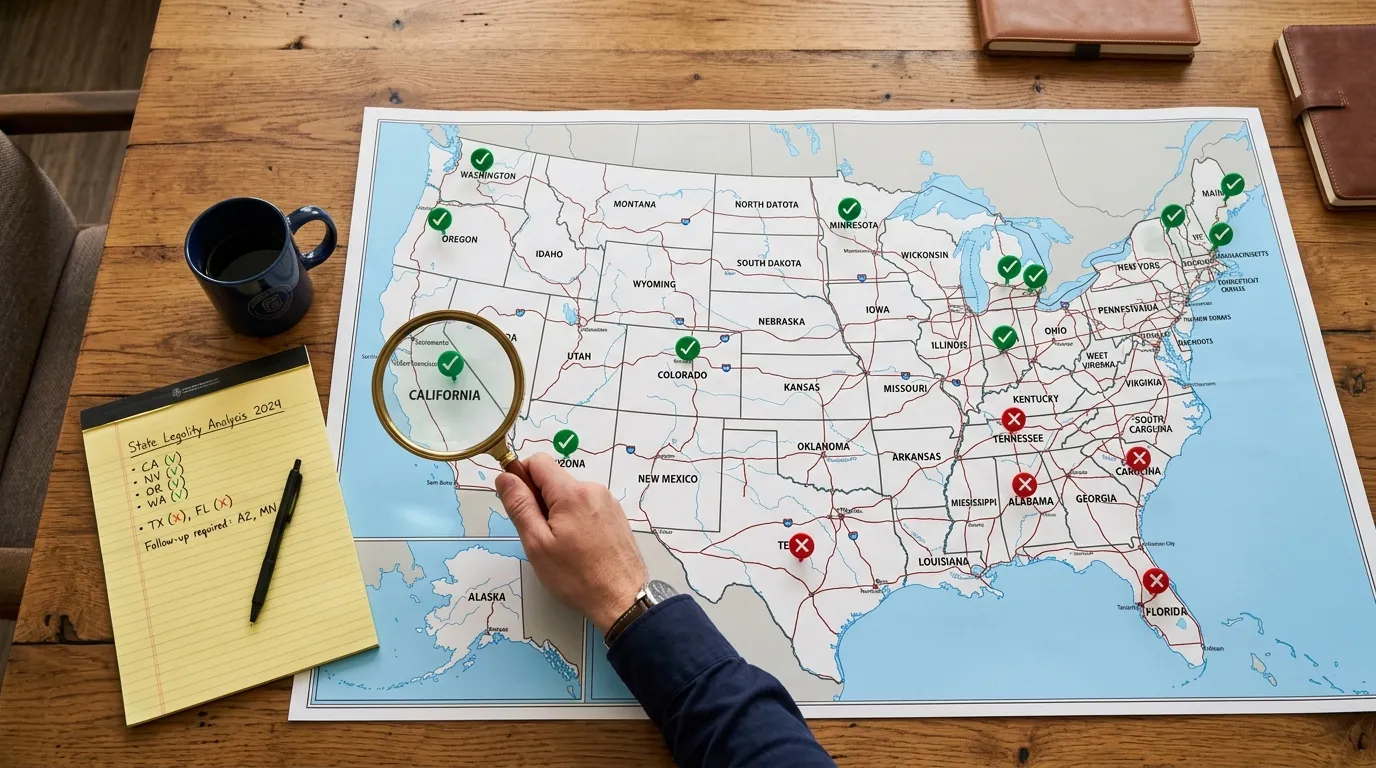
Before you create an account, claim a welcome bonus, or spin a single slot, one question matters above all others: can you legally play from where you live? Sweepstakes casinos operate under a patchwork of state regulations that creates a fractured legal landscape across the United States—accessible in most places, prohibited in others, and increasingly contested everywhere.
The baseline picture favors players. Sweepstakes casinos currently operate legally in more than 35 US states, compared to just seven states where regulated iGaming has launched, according to KPMG’s 2025 industry analysis. This disparity exists because sweepstakes platforms structure their operations around promotional sweepstakes law rather than gambling law—a distinction that opens doors across most of the country.
The legal theory is straightforward: traditional gambling requires consideration (payment), chance, and prize. Remove consideration by offering free entry methods, and the activity becomes a promotional sweepstakes rather than gambling. Players can always obtain Sweeps Coins without purchase through daily logins, mail-in requests, and social media giveaways, which theoretically removes the payment element that triggers gambling regulations.
Not every state accepts this interpretation. Some have explicitly banned sweepstakes casinos through legislation. Others have issued attorney general opinions declaring them illegal gambling. Still others occupy a gray zone where enforcement remains uncertain. The difference between playing legally and violating state law can come down to which side of a state line you happen to be sitting on.
This guide maps the current legal landscape as of 2026, identifies states with explicit bans and restrictions, tracks pending legislation that could change the picture, and provides practical guidance for staying compliant wherever you play. Know before you play—it’s the only safe approach in a fragmented regulatory environment.
Understanding State Restrictions
States regulate sweepstakes casinos through several mechanisms, and the type of restriction matters for both legal exposure and practical access. Understanding how your state approaches the issue helps you assess actual risk rather than operating on assumptions.
Legislative bans represent the most definitive form of restriction. When a state legislature passes a law explicitly prohibiting sweepstakes casinos, that prohibition carries the full weight of statutory authority. Violations can trigger criminal penalties, civil fines, or both. California’s AB 831, which took effect January 1, 2026, exemplifies this approach—clear statutory language making sweepstakes casino operation and participation illegal within state borders.
Attorney general opinions occupy a middle ground. When a state AG issues a formal opinion declaring sweepstakes casinos constitute illegal gambling under existing law, that interpretation guides enforcement decisions without requiring new legislation. AG opinions carry legal weight but can be challenged in court, and subsequent AGs might reverse their predecessors’ positions. The enforceability is real but potentially less permanent than statutory bans.
Gaming commission enforcement actions target operators directly. State gaming regulators can issue cease-and-desist orders, assess fines, and refer cases for prosecution when they determine sweepstakes platforms violate existing gambling laws. Louisiana’s Gaming Control Board, for example, sent over 40 cease-and-desist letters to various online operators including sweepstakes platforms during 2025.
The impact of California’s ban illustrates what large-state restrictions mean for the industry. California represented 17.3% of the entire US sweepstakes casino market—approximately $2.42 billion in player spending—according to the SGLA’s California impact report. Losing access to the nation’s most populous state removes roughly one-sixth of the addressable market overnight.
Enforcement intensity varies dramatically even among states with restrictions. Some actively pursue operators and payment processors; others have laws on the books but limited resources or political will for enforcement. This inconsistency creates confusion for players trying to assess practical risk versus theoretical illegality.
Platform-level blocking adds another layer. Many sweepstakes casinos block registration and access from restricted states proactively, using IP geolocation and address verification to prevent players from participating where the platform has determined legal risk exists. You might not be able to access a platform even if your state hasn’t explicitly banned sweepstakes casinos—the operator’s risk assessment drives the decision.
Federal versus state jurisdiction creates jurisdictional complexity. The federal government generally leaves gambling regulation to states, but federal law applies to interstate gambling operations. Sweepstakes platforms operating across state lines navigate both frameworks, typically relying on promotional sweepstakes exemptions at the federal level while managing state-by-state compliance at the local level.
Industry self-regulation adds another dimension. Major sweepstakes casino operators voluntarily implement geographic restrictions in states where they assess legal risk, even absent explicit prohibition. This proactive blocking protects operators from enforcement action but can frustrate players in states where sweepstakes casinos remain technically legal. The operator’s risk calculation, not state law alone, determines actual access.
Consumer protection frameworks vary by state. Some states with active restrictions cite consumer protection concerns—arguing that unregulated sweepstakes platforms lack responsible gambling tools, adequate customer support, or transparent odds disclosure. These concerns have merit: the American Gaming Association has documented that sweepstakes operators often lack the robust responsible gaming protocols required of licensed casinos. Whether restriction serves consumer protection or industry protection remains debated.
Tax implications of state-level regulation affect both operators and players. States with regulated gambling markets collect substantial tax revenue—commercial casinos contributed over $15.9 billion in gaming taxes nationally during 2024. Sweepstakes platforms operating outside state regulatory frameworks don’t contribute to these tax bases, creating fiscal incentive for restriction beyond pure regulatory concern.
Complete List: Banned and Restricted States
Seventeen states had implemented bans or significant restrictions on sweepstakes casinos as of early 2026, according to tracking by Lines.com’s state legality database. This list continues to evolve as additional states consider legislation and existing restrictions face legal challenges.
Washington maintains one of the oldest and most comprehensive bans on sweepstakes casino activity. The state classifies online gambling broadly and has actively enforced against sweepstakes platforms. Players in Washington cannot legally participate, and most platforms block access entirely from Washington IP addresses.
Idaho prohibits sweepstakes casinos under its interpretation of state gambling law. The state’s relatively small population means less industry focus, but the restriction is clear and platforms generally block Idaho residents.
Nevada presents an interesting case: the state with the most permissive gambling laws in the country actually restricts sweepstakes casinos. Nevada regulators view unregulated sweepstakes platforms as competition to the licensed casino industry and have acted accordingly. If you’re in Las Vegas, the nearest sweepstakes casino is legally further away than the slot machines in the airport.
Montana became the first state to explicitly ban sweepstakes casinos through Senate Bill 555, signed by Governor Greg Gianforte and effective October 1, 2025. The legislation carries severe penalties: up to 10 years imprisonment and fines up to $50,000. Montana’s comprehensive approach set a precedent that other states have since followed.
California’s ban took effect January 1, 2026, through Assembly Bill 831. The legislation carries serious penalties: violations can result in up to one year imprisonment and fines up to $25,000, with liability extending to vendors and service providers who facilitate sweepstakes casino operations, as analyzed by law firm Zwillgen’s legal review. The breadth of this legislation—penalizing not just operators but also payment processors and technology vendors—represents a more aggressive approach than earlier state bans.
Michigan has taken enforcement action against sweepstakes casinos, with the Gaming Control Board declaring them illegal under state law. The state’s executive director publicly stated that illegal gambling operations are not welcome in Michigan.
Connecticut banned sweepstakes casinos through Senate Bill 1235, signed by Governor Ned Lamont in June 2025 and effective October 2025. The state moved decisively to protect its tribal gaming partnerships and emerging regulated online gambling market from unregulated competition.
Georgia, while not having an explicit sweepstakes casino ban, restricts most forms of online gambling and many platforms choose not to operate there due to legal uncertainty.
South Carolina, despite being home to SGLA’s executive director, maintains restrictions on sweepstakes casino activity that prevent legal operation within the state.
Additional states with varying levels of restriction include Kentucky, Utah, Hawaii, and Alabama. Utah and Hawaii prohibit most forms of gambling entirely, leaving no room for sweepstakes casino arguments. Kentucky and Alabama have gambling restrictions that create legal risk for sweepstakes participation.
US territories present their own considerations. Puerto Rico, Guam, and other territories generally fall outside the scope of state-level gambling regulations but may have their own restrictions. Players in territories should verify local law rather than assuming mainland rules apply.
Platform-specific restrictions sometimes exceed state-level requirements. A platform might block access from a state where sweepstakes casinos remain technically legal if the operator’s legal team assesses elevated risk. Always check your specific platform’s terms of service for geographic restrictions beyond what state law requires.
The distinction between banned and restricted matters for practical purposes. A full ban means the state has declared sweepstakes casinos illegal and platforms block all access. A restriction might mean certain features are unavailable, purchase amounts are limited, or specific platform operators have chosen not to serve the state while others continue. Understanding your state’s specific situation—not just whether it appears on restriction lists—determines what you can actually do.
Enforcement patterns reveal practical risk levels. Washington actively pursues sweepstakes casino cases; other restricted states might have laws on the books without meaningful enforcement resources devoted to individual players. This doesn’t make participation legal, but it affects the practical risk assessment that players ultimately make for themselves.
State border complexities arise for players who live near state lines or split time between multiple states. A player who lives in legal Oregon but works in restricted Washington faces questions about where they can play. Most platforms define eligibility based on permanent residence rather than current physical location, but terms vary and technical access based on IP detection adds another layer of complexity.
Pending Legislation: What’s Coming
The legislative pipeline for sweepstakes casino restrictions extends well into 2026 and beyond. Several states have introduced or are actively considering bills that would ban or significantly restrict sweepstakes platforms, suggesting the current legal landscape will continue shifting.
New Jersey enacted sweepstakes casino restrictions in August 2025 through A5447. As one of the few states with a mature regulated iGaming market, New Jersey moved decisively to limit competition from unregulated platforms, protecting its established online gambling industry.
Mississippi moved forward with sweepstakes casino restrictions during 2025, driven by its established casino industry seeking protection from online competition. The state’s casino lobbying influence makes eventual restriction likely, though timing remains uncertain.
Maryland examined potential restrictions, balancing its emerging regulated gambling market against sweepstakes platform access. The state’s legislative process moves deliberately, but the direction of policy discussion trends toward restriction.
New York enacted sweepstakes casino restrictions through Senate Bill S5935A, signed in December 2025. The legislation prohibits online sweepstakes games and establishes penalties ranging from $10,000 to $100,000 per violation, with liability extending to financial institutions, payment processors, and platform providers. Major sweepstakes operators including VGW have already terminated their operations in the state.
Florida’s consideration of restrictions carries enormous market implications. The state’s size and demographic composition make it one of the largest sweepstakes casino markets nationally. Industry analysis suggests Florida accounts for over 8.5% of sweepstakes revenue—more than $1 billion in player purchases annually.
“This issue has brought lawmakers together that it represents illegal gambling and revenue theft in many states. Rarely do we agree on anything as lawmakers, but on this issue, we agree that this represents illegal gambling operations.” — Shawn Fluharty, West Virginia Delegate and President, National Council of Legislators from Gaming States
This bipartisan consensus among state legislators suggests that additional restrictions are likely regardless of political composition. The National Council of Legislators from Gaming States provides a forum for coordinating regulatory approaches, and its leadership’s position signals the direction of policy development.
Industry response to pending legislation involves both legal challenge and legislative engagement. The Social Gaming Leadership Alliance actively lobbies for regulation rather than prohibition, arguing that bringing sweepstakes casinos into a taxed, regulated framework benefits states more than outright bans. This argument has gained limited traction but faces opposition from established gambling interests.
Timeline uncertainty affects player planning. Bills can move from introduction to passage within a single legislative session, or they can stall for years. Players in states with pending legislation face the difficult question of whether to build balances on platforms that might become inaccessible. There’s no perfect answer—staying informed about your state’s legislative calendar provides the best available guidance.
Court challenges could alter the trajectory. Legal challenges to state bans might eventually reach courts that interpret the promotional sweepstakes model favorably, potentially invalidating restrictions. Conversely, court decisions affirming state authority to ban sweepstakes casinos would strengthen the legal foundation for additional restrictions.
The regulated versus unregulated framing shapes legislative debate. Proponents of restriction often argue that sweepstakes casinos represent unregulated gambling that should be brought under state oversight or eliminated entirely. Proponents of sweepstakes platforms counter that their promotional model is fundamentally different from gambling and should remain legal as a consumer entertainment option. Both sides present legitimate points; legislators ultimately decide which framework applies.
Economic impact arguments cut both ways. Restriction advocates point to lost tax revenue and competition with regulated operators. Sweepstakes supporters cite job creation, advertising spending, and payment processing activity that benefits state economies. California’s sweepstakes industry reportedly supported over 1,100 jobs and generated $802 million in direct economic activity before the ban took effect—figures that complicate simple “ban it all” approaches.
Compliance Tips for Players
Playing within the rules protects both your legal standing and your accumulated balances. These practical guidelines help you navigate the fractured regulatory landscape without running afoul of state restrictions.
VPNs don’t work as a compliance workaround. While a VPN can mask your IP address to appear as though you’re in a different state, sweepstakes casinos require identity verification for redemption. Your KYC documents—driver’s license, utility bills, bank statements—reveal your actual residence. Players who register from restricted states using VPNs risk account termination and forfeiture of all balances when they attempt to verify for redemption.
Address verification happens at registration and redemption. Even if you initially access a platform without issues, attempting to redeem Sweeps Coins triggers KYC review that confirms your location. There’s no scenario where a restricted-state player successfully cashes out—the verification process catches geographic ineligibility.
Moving between states creates specific considerations. If you relocate from a legal state to a restricted one, your existing account may become inactive for redemption purposes. Most platforms require that your verified residence be in a legal state at the time of redemption, not merely at the time of registration. Conversely, moving from a restricted state to a legal one opens access—you’d update your address and verify your new location to enable full account functionality.
Temporary travel to restricted states presents a gray area. Most platforms prohibit play while physically located in restricted states, even if your permanent residence is legal. IP-based blocking may prevent access; terms of service violations may apply even if technical access remains possible. Playing while traveling through Washington or Nevada on a road trip could theoretically violate platform terms, though enforcement typically focuses on permanent residence rather than transient location.
Existing balances when bans take effect remain a contested area. When California banned sweepstakes casinos, players with existing balances faced uncertainty about whether they could redeem prior to the effective date. Platform policies varied—some allowed expedited withdrawal windows, others froze accounts entirely. If your state is considering restrictions, redeeming accumulated balances sooner rather than later removes this risk.
Account closure procedures differ by platform. If you want to close an account due to relocation or legal concerns, check whether the platform requires balance withdrawal first, how forfeited balances are handled, and what documentation you’ll receive confirming closure. Clean account termination prevents future complications.
Staying informed requires ongoing attention. State legislation can move quickly, and platforms don’t always provide advance notice of access changes. Following industry news, checking your state legislature’s calendar, and periodically reviewing platform terms of service keeps you aware of developments that affect your playing ability.
Document everything related to your accounts. Screenshots of balances, records of purchases, copies of redemption confirmations—this documentation becomes valuable if disputes arise about account status, particularly during transitions when state laws change. Players who redeemed successfully just before California’s ban took effect had documentation proving their timely action; those who waited faced more complicated situations.
Multiple platform diversification reduces geographic risk. If you spread activity across several sweepstakes casinos rather than concentrating on one, a restriction affecting a single platform doesn’t wipe out your entire position. This strategy carries its own costs—splitting play means slower progress toward thresholds on each platform—but provides insurance against platform-specific or state-specific access changes.
Legal counsel matters for significant amounts. If you have substantial balances and face a restriction affecting your ability to redeem, consulting an attorney familiar with gaming law provides guidance specific to your situation. Most players don’t need legal advice for casual play, but high-balance players facing account freezes due to state action might benefit from professional guidance on their options.
Know Before You Play
The legal landscape for sweepstakes casinos is neither uniformly permissive nor universally restrictive—it’s a state-by-state patchwork that demands attention before you invest time and money into building balances on any platform.
The majority position still favors player access. More than 35 states permit sweepstakes casino operation, meaning most Americans can participate legally. But the trend line points toward additional restrictions as state legislators respond to pressure from established gambling interests and concerns about unregulated online gaming.
Verification before play saves complications later. Confirming your state’s status takes minutes; discovering you’ve accumulated unredeemable balances takes much longer to resolve. Check both your state’s legal position and your chosen platform’s geographic restrictions before creating an account.
The regulatory environment will continue evolving. States that permit sweepstakes casinos today might restrict them tomorrow. States considering bans might ultimately choose regulation instead. Court decisions could reshape the legal framework entirely. Staying informed isn’t optional for serious players—it’s the price of participation in an industry that exists in regulatory flux.
When in doubt, verify. Platform terms of service, state attorney general websites, and industry news sources all provide information about your specific situation. The legal landscape is complicated enough that assumptions carry real risk. Know before you play—every time.